
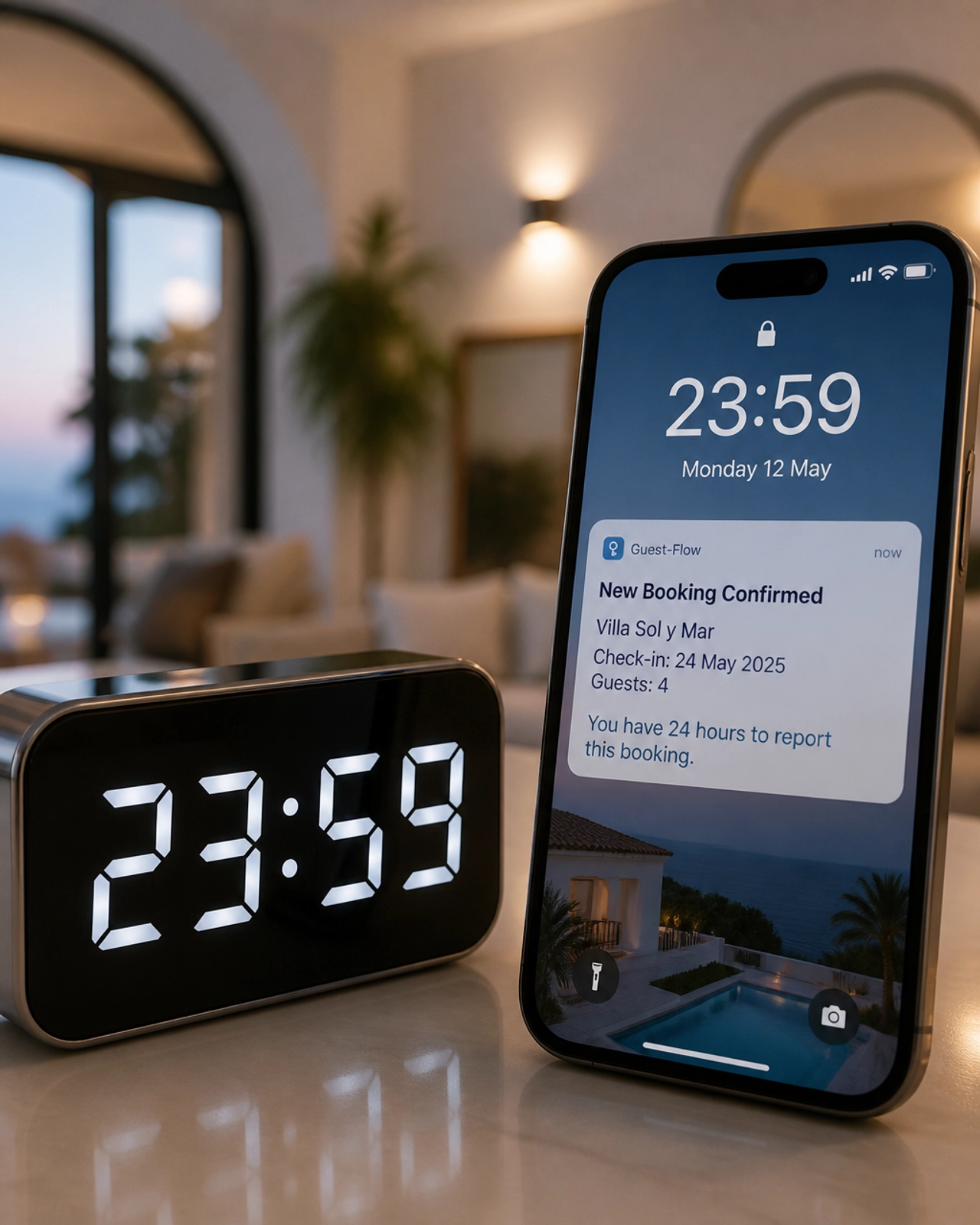
If you rent your Spanish holiday property through Airbnb or Booking.com, you may assume the platform handles guest registration. It does not.
Royal Decree 933/2021 makes holiday rental owners — not platforms — legally responsible for submitting guest ID data to SES Hospedajes. Understanding this distinction is the difference between compliance and a fine of up to €30,000.
What Airbnb and Booking.com actually do
Both Airbnb and Booking.com collect information from guests during the booking process. Airbnb may ask guests to provide ID for its own identity verification programme. Booking.com collects passport data for certain property types under its "Traveller ID Collection" feature in some countries.
Neither of these systems is SES Hospedajes. Neither platform submits data to the Spanish Ministry of Interior on your behalf.
What the platforms do:
- Collect booking information and identity documents for their own systems
- Provide you with guest contact details before arrival
- May collect ID documents in some markets for their own compliance purposes
What the platforms do not do:
- Submit data to Spain's SES Hospedajes system
- File reports with the Ministerio del Interior under Royal Decree 933/2021
- Ensure your compliance with Spanish holiday rental law
The law is clear: the owner is responsible
Royal Decree 933/2021 — in force since December 2024 — places the compliance obligation squarely on the "responsible party", defined as the owner or operator of the tourist accommodation. This does not change because you list on a platform.
For each guest over 14 years old, you must:
- Collect their full name, nationality, document type, document number, and date of birth
- Submit this data to SES Hospedajes within 24 hours of their arrival at the property
- Retain a record of each submission for three years
Missing the 24-hour window — even by a few hours — constitutes a breach. The data must be submitted within the window, not merely collected within it.
The 24-hour window problem for Airbnb hosts
SES Hospedajes requires submission within 24 hours of the guest's physical arrival. For self-check-in properties — which is most Airbnb listings — this creates a practical challenge: the guest arrives without a host present, often at an unpredictable time, and you may not know the exact moment the 24-hour clock starts.
A guest who checks in at 11pm means the window closes at 11pm the following day. If a guest arrives and you have not yet collected their ID document, there is no grace period. The regulation does not make allowances for late arrivals, early check-ins, or hosts who are in a different time zone.
Airbnb's messaging tools and automated check-in instructions are not connected to SES Hospedajes in any way. Sending a pre-arrival message asking for a passport photo is a common workaround — but it leaves you dependent on the guest cooperating, and it still requires you to manually submit that data to the government portal.
What happens if you rely on the platform?
Many Spanish holiday rental owners discovered this the hard way in late 2024 and early 2025, when enforcement by the Guardia Civil and local authorities began in earnest. Common incorrect assumptions include:
"Airbnb verified my guest's ID so I'm compliant." Airbnb's identity verification is not SES Hospedajes. The two systems are completely separate.
"I have Booking.com's Traveller ID collection enabled." Booking.com's traveller data collection serves Booking.com's own requirements. It is not integrated with Spain's SES Hospedajes portal and does not fulfil Royal Decree 933/2021.
"The platform holds the booking contract, so the platform is liable." The regulation disagrees. You are the accommodation operator. The obligation is yours.
Fines under Royal Decree 933/2021 range from €600 for minor breaches to €30,000 for severe or repeated non-compliance. A pattern of missing submissions — which can be identified during an inspection of your submission records — is treated as a serious breach.
How Villa Check In handles SES Hospedajes for OTA hosts
Villa Check In works with Airbnb and Booking.com hosts across Spain. Our process is built around how self-check-in rentals actually work:
- We provide a guest-facing registration link you can include in your Airbnb or Booking.com check-in instructions
- Guests complete a simple, mobile-friendly form — in any language — before or at arrival
- Our team reviews every submission for errors before sending it to SES Hospedajes
- You receive confirmation that the submission is complete, together with a timestamped record for your compliance documentation
You do not need to chase individual guests for documents, manually navigate the government portal, or worry about whether the submission arrived on time.
Making compliance work alongside your OTA workflow
Whether you manage your Airbnb or Booking.com listings directly, or use a local property manager, the SES Hospedajes obligation applies. The simplest path to compliance for OTA hosts involves three elements:
- Include a registration link in every check-in message or automated pre-arrival communication
- Use a managed service that handles submission and error-checking on your behalf
- Keep records of every submission for the required three-year period
Villa Check In handles all three. If you want to discuss how we can integrate with your existing Airbnb or Booking.com workflow, apply for our service here.