

Owning property in Spain has never been more rewarding — or more legally complex. As we move through May 2026, landlords across the Peninsula and the Islands face a critical crossroads. The rules of the short-term vs long-term rental Spain debate just changed again, thanks to a landmark Supreme Court decision that sent shockwaves through the holiday-let industry.
Both paths carry significant risks — from the "Okupa" (squatting) crisis to the relentless reporting requirements of SES Hospedajes. This guide breaks down the financial trade-offs, legal hurdles, and the regulatory shifts that define the Spanish rental market in 2026.
The 2026 Regulatory Reset: National NRA Struck Down
On 21 May 2026, the Spanish Supreme Court (Tribunal Supremo) issued a definitive ruling that fundamentally altered property registration. The court struck down the national NRUA (Número de Registro de Alquiler) registry — the central government's attempt to create a unified, state-wide database for all short-term rentals.
What the Supreme Court Ruling Means for You
The court ruled that regulating tourism is a regional power, not a national one. This decision effectively annuls the requirement for a national NRA number, but it does not mean the end of regulation.
- Regional licences remain mandatory. Your property still needs a valid regional tourist licence (such as a VV in the Canaries or a VFT in Andalusia).
- National bureaucracy is reduced. You no longer need to navigate the state-level Digital Single Window for an additional NRA code — a major relief for owners tired of redundant paperwork.
- Platform verification changes. Airbnb and Booking.com are currently updating their systems to revert to regional identification numbers as the primary legal requirement.
Maintain your regional compliance and focus on local town hall regulations, as these now hold more weight than ever. If you are unsure which licence applies to your property, our VV licence guide explains the regional requirements in full.
The Short-Term Struggle: Compliance as a Full-Time Job
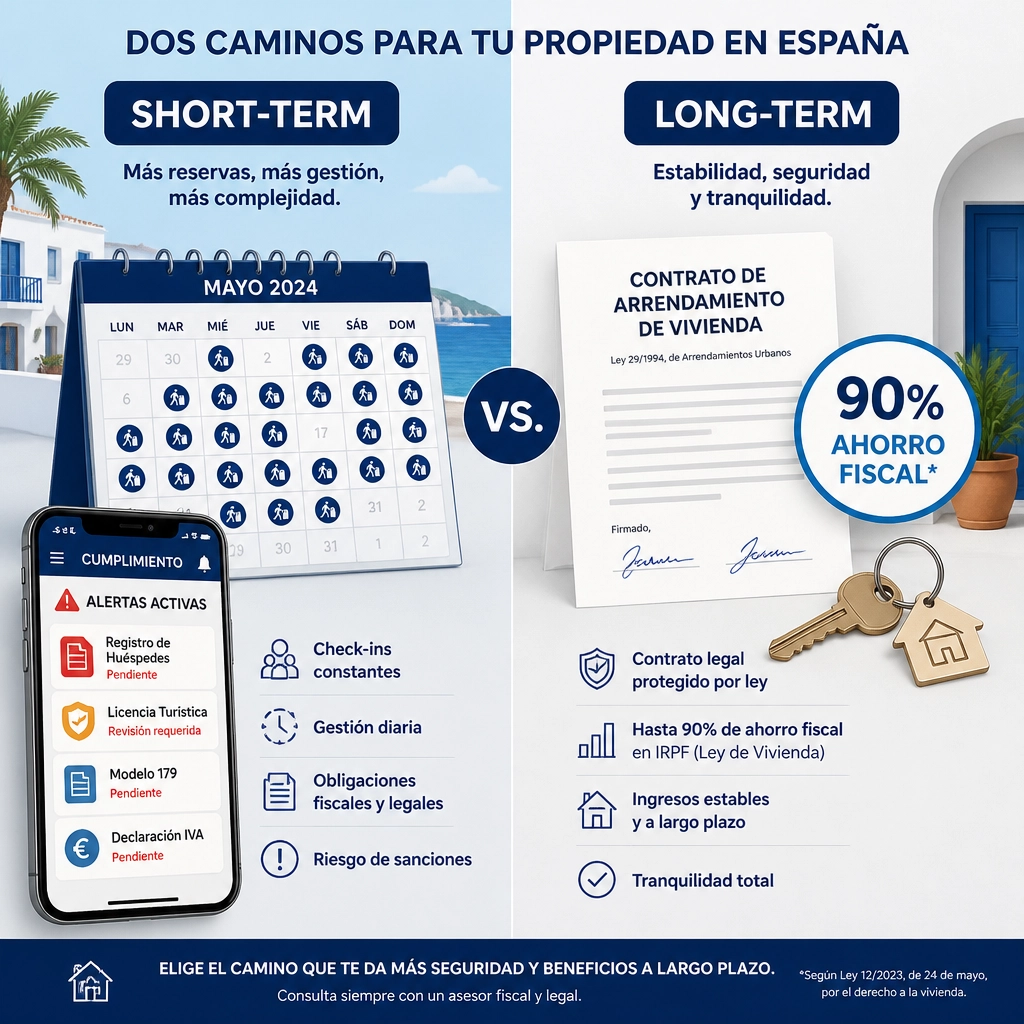
Holiday rentals still offer the highest potential gross yields, often doubling or tripling what a long-term tenant would pay. However, these yields come at a price — extreme administrative burden.
Mastering SES Hospedajes Reporting
The most significant hurdle for short-term owners remains the SES Hospedajes platform. Under Royal Decree 933/2021, you are legally required to report over 30 data fields for every single guest over the age of 14.
- Submit bookings immediately. You must report booking data as soon as a reservation is made, not just when the guest arrives.
- Register guests within 24 hours. Failure to submit guest data within the 24-hour check-in window can result in fines ranging from €600 to €30,000.
- Manage digital certificates. You need a valid, updated digital certificate to access government portals — a technical barrier many find frustrating.
Our guest registration service handles SES Hospedajes submissions automatically the moment you add a booking, ensuring you never miss a deadline or face a penalty.
The Long-Term Lure: Tax Breaks and Stability
If the administrative weight of holiday lets feels too heavy, the Spanish government has introduced powerful incentives to encourage long-term residential renting. For the right owner, the tax savings can be significant.
The 90% Tax Reduction
Under the current Housing Law, landlords who rent their property as a primary residence can benefit from substantial IRPF (Personal Income Tax) reductions.
- Base 50% reduction. Available for any standard long-term residential lease.
- Up to 90% reduction. If your property is in a "tensioned housing area" and you reduce the rent by at least 5% compared to the previous contract, you only pay tax on 10% of your net rental income.
These incentives are designed to ease the housing crisis by making long-term rentals more profitable than short-term lets after taxes are calculated. For many Spanish tax residents, this makes the long-term path a financial no-brainer.
The Shadow of the Okupa Crisis and Rent Caps
While the tax breaks are tempting, long-term renting in Spain carries unique risks. The balance of power remains heavily tilted toward the tenant.

Mandatory Extensions and Rent Caps
When you sign a long-term lease (LAU contract) in 2026, you are making a significant commitment.
- Five to seven year lock-in. Individual landlords must allow tenants to stay for up to 5 years, while companies must allow 7 years, provided the tenant meets their obligations.
- Continuing rent caps. Rent increases are strictly controlled. While the previous 2% cap has evolved into a new reference index, the goal remains the same — to prevent rent from rising alongside inflation.
- Mandatory extensions. Even after the initial period, tacit renewals can extend a contract for several more years, making it difficult to recover the property for personal use.
The Squatting and Non-Payment Risk
The "Okupa" crisis — where individuals illegally occupy a property — has seen some legal improvements in 2025 and 2026, with faster 48-hour police removal powers for clear trespassers. However, the "Inquilino Okupa" — a tenant who enters legally but stops paying — remains a major problem.
Evicting a non-paying tenant can still take 10 to 18 months, especially if the tenant is declared "vulnerable" by the courts. During this time, you may receive zero income while still being responsible for mortgage payments and taxes.
Financial Trade-offs: A Side-by-Side Comparison
| Feature | Short-Term (Holiday) | Long-Term (Residential) | | :--- | :--- | :--- | | Gross Yield | High (8–12%+) | Moderate (3–5%) | | Tax Burden | High (standard rates) | Very low (up to 90% reduction) | | Management | Intense (guest turnover, cleaning) | Low (single tenant) | | Compliance | Heavy (SES Hospedajes, licences) | Moderate (LAU contracts, deposits) | | Risk | Vacancy / regulatory changes | Non-payment / Okupa / rent caps | | Flexibility | High (use the villa yourself) | Low (locked in for 5–7 years) |
Choosing Your Path: How Villa Check In Helps
Many owners are finding that the holiday rental dream is becoming a compliance nightmare, while others are concerned about the legal risks of long-term leasing. At Villa Check In, we specialise in removing the friction from whichever path you choose.

Expert Support for Every Scenario
- Obtain your digital certificate. We are an approved authority and can issue your certificate remotely, ensuring you can access any government portal from anywhere in the world. Find out more.
- Automate your compliance. If you choose to stay in the short-term market, our managed guest registration service handles everything from self-check-in to direct SES Hospedajes submission.
- Navigate the licensing maze. We assist with VV licence applications and Modelo 400 registrations, ensuring you are 100% legal from day one.

Conclusion: Take Control of Your Investment
The Spanish rental market in 2026 is no place for the DIY landlord. Between the Supreme Court's sudden shifts and the high stakes of the Housing Law, making the wrong move can cost you thousands in fines or years of legal battles.
Assess your goals — determine whether you value the flexibility of short-term yields or the tax-sheltered stability of a long-term lease. Whichever you choose, ensure you have the right digital tools and expert advice to stay compliant and profitable.
Ready to simplify your Spanish property management? Contact our team today for a compliance audit or consultation.