
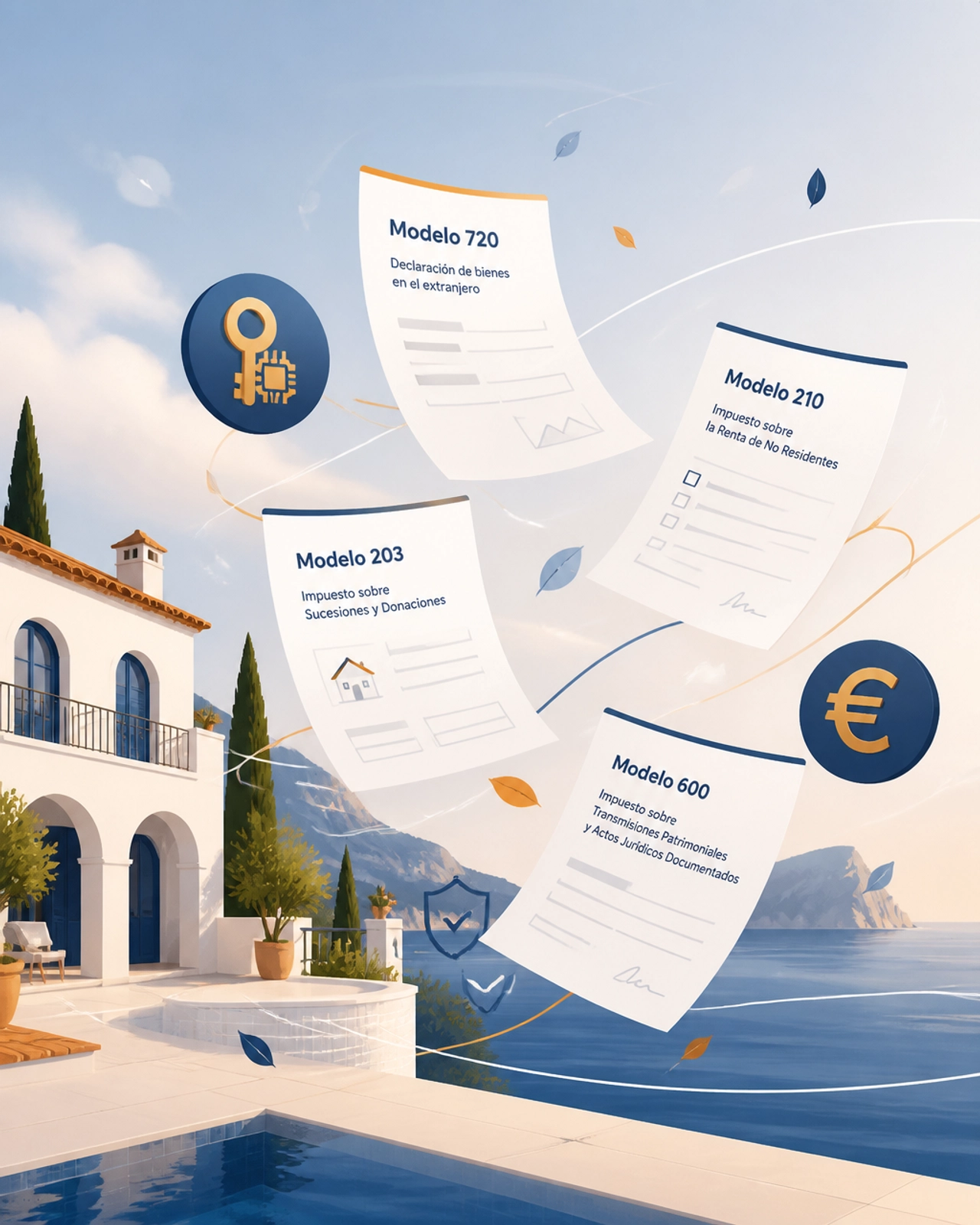
Owning a property in Spain is often the culmination of a lifelong dream — a sun-drenched escape where the pace of life slows down and the Mediterranean breeze takes over. However, the dream can quickly feel like a bureaucratic puzzle once you encounter the "Modelo" system. If you are a non-resident owner, the Spanish tax office (Agencia Tributaria) communicates through a series of numbered forms that can feel like a secret code.
Understanding these forms is not just about staying on the right side of the law — it is about protecting your investment and ensuring your peaceful retreat doesn't become a source of stress. Whether you use your villa for personal holidays, rent it out to tourists, or are looking to sell, there is a specific Modelo for you. This guide breaks down the essential tax forms every non-resident property owner must know in 2026.
Modelo 210: The Non-Resident Income Tax
This is the "heavyweight" of Spanish tax forms. If you own property in Spain but do not live there for more than 183 days a year, Modelo 210 will be your most frequent contact with the tax authorities. It covers two very different scenarios that often confuse owners.
Imputed Income (Uso Propio)
Even if you never rent out your property and it sits empty for ten months of the year, Spain still considers it a source of "imputed income." Essentially, the government believes that owning a second home provides you with a benefit that should be taxed.
- The Deadline: You must file this annually, any time between January 1 and December 31 of the year following the tax year. For example, your 2025 imputed income tax must be filed by the end of 2026.
- The Calculation: This is based on the valor catastral (rateable value) of the property — usually 1.1% to 2% of that value is considered "income," which is then taxed at the non-resident rate.
Rental Income
If you do rent your property out, you must declare the actual income earned. As of the latest 2026 regulations, owners have a significant choice.
- The New Annual Window: You can now choose to group all your rental income for the year into a single filing. This must be done between January 1 and January 20 of the following year.
- Quarterly Filing: If you prefer, you can stick to the traditional quarterly system, filing in the first 20 days of April, July, October, and January.
- The Rates: Non-residents from EU/EEA countries typically pay 19%, while those from outside the EU (including the UK) pay 24%.
Modelo 030: Your Identity at the Tax Office
Think of Modelo 030 as your "registration card" with the Spanish tax authorities. It is the form used to notify the government of your personal details, your Spanish address (the property), and your home address abroad.
You only need to file this when your situation changes. If you move house in your home country, change your name, or want to update your representative in Spain, you submit Modelo 030. It is a vital step because it ensures all tax notifications reach you correctly — missing a government letter because they had an old address is never a valid excuse for late payment.
Modelo 211: The 3% Withholding on Sales
If the day comes when you decide to sell your Spanish property, Modelo 211 becomes critical. In Spain, when a non-resident sells a property, the buyer is legally required to withhold 3% of the total purchase price and pay it directly to the tax office on your behalf using this form.
This acts as a "guarantee" for the tax office that you will pay your capital gains tax. Once the sale is complete, you then file your own Modelo 210 to calculate the actual gain. If the tax you owe is less than the 3% withheld, you can apply for a refund — but be prepared to wait, as this process can take several months.
Modelo 400 and 420: The Canary Islands Specialty
If your property is located in the Canary Islands, you operate under a different tax regime known as IGIC (Impuesto General Indirecto Canario) instead of mainland VAT.
- Modelo 400: This is the registration form. Any owner wanting to rent their property out in the Canaries must register for an IGIC number using Modelo 400. This is a prerequisite for obtaining your Canary Islands tourist licence.
- Modelo 420: Once registered, you must file quarterly IGIC returns. Even if you had zero guests in a particular quarter, you must still file a nil return to remain compliant.
Modelo 714: The Wealth Tax (Patrimonio)
While most owners focus on income tax, those with high-value portfolios must keep an eye on Modelo 714. This is the Wealth Tax declaration.
In Spain, non-residents are taxed on the net value of their Spanish assets. Generally, there is an individual allowance of €700,000. If your Spanish property — minus any outstanding mortgage — is worth more than this, you may be required to file Modelo 714. Rates vary by region, but it is an essential check for any luxury property owner to ensure they aren't accidentally accumulating a debt with the tax office.
Don't Forget the IBI — Council Tax
While not technically a "Modelo" (as it is collected by the local town hall, not the national tax office), the IBI (Impuesto sobre Bienes Inmuebles) is the most important annual bill you will pay.
It is the Spanish equivalent of council tax. The amount depends on the location and the valor catastral of your property. Most owners set up a direct debit for this, but it is vital to check that it is being paid every year. Failure to pay IBI can eventually lead to the local government placing a charge against the property.
The Master Key — Your Digital Certificate
Managing five or six different tax forms from abroad might seem impossible, but there is a tool that makes it significantly easier — the Digital Certificate.
A Digital Certificate is an encrypted file that acts as your official electronic ID in Spain. It allows you to:
- File Modelos online: You can submit your own tax returns directly on the Agencia Tributaria website without needing to visit a bank or a tax office.
- Access notifications: You can log in to your personal area on the government portal to see if they have sent you any letters.
- Register guests: It is mandatory for accessing the SES Hospedajes platform to register your guests — find out more about our guest registration service.
At Villa Check In, we act as an authorised certification authority. We can issue your Digital Certificate remotely, meaning you don't need to fly to Spain just to stand in a government office queue.
Simplifying the Complex
The list of Spanish tax forms can feel overwhelming, but they all serve a simple purpose — keeping your property legal and your ownership secure. By staying organised and using tools like the Digital Certificate, the "bureaucratic nightmare" becomes a manageable annual routine.
- Audit your obligations: Do you need a Modelo 210 for personal use or rental income?
- Check your location: Are you in the Canaries and need a Modelo 400?
- Update your records: Is your Modelo 030 up to date with your current home address?
If you feel like you are drowning in paperwork, remember that you don't have to navigate this alone. Whether it is managing your guest registrations or securing your Digital Certificate, our team is here to ensure you spend more time enjoying your villa and less time decoding tax forms. View our services and pricing to get started.